A few months ago I was approached by the Starnes Group to design a campaign identity for the SpeakUp College Tour presented by Kyros Entertainment. The tour is designed to present brands such as Tyndale, Nav Press, LifeWay, Intervarsity, CCM, One campaign, The House Studio, Kerusso, Provident, EMI, Light Gives Heat, and more to students at Christian colleges. Although a logo design wasn’t part of the original proposal I felt that we needed an identifiable mark for recognition. Prior tour graphics, while very cool and progressive, felt a bit dated. I began researching display typefaces that were distinct with a hand-drawn feel. I discovered Sketchetica which is just a fun, drawn version of Helvetica. As I played with the words “Speak,” “Up,” Tour,” and “.com,” I found a tight arrangement that I thought would serve to be eye-catching and memorable. I proceeded to add a little sketch-y vector brush stroke to the type and ended up with a very fun graphic that would serve as a quick logo. I must admit I love bright orange which explains the fire-y flare. This served as a 2 toned color scheme for the campaign.

Next, I needed to set a mood. For some reason, this didn’t take long to decide. I grabbed the nearest Moleskine-like journal and scanned a blank page to get that subtle texture for the background. By incorporating Sketchetica for headlines and a cut-out style banner here and there, I just began placing information in a hierarchy. This became my approach to all pieces. I began with designing the postcard which was to be handed out to students on college campuses. This same mood and feel translated over nicely to the landing and download pages for the web site.

Designing the look of the web site was a lot of fun. Because I’m not a code guy, I usually get overwhelmed by trying to figure out how to put great ideas into HTML, CSS, PHP, and the like. Not so on this project. The Great Steven Peercy was commissioned to program the back end of this simple site which gave me free reign to exercise my creativity. O the delight to see my designs come alive with rollovers, working forms, and smooth functionality!

Although this was a small and quick project, I was given a lot of room for creativity which makes my job a lot of fun. Special thanks to Brock Starnes for excellent management and business acumen. Visit www.speakuptour.com to see the real thing up and running.

Landing Page for the Speak Up Tour

Downloads Page of Speak Up Tour's Web Site

Overhauling an entire publication has been a long-time desire of mine. Although I have worked for nearly all of the VIP magazines over the last several years, I’ve not had the chance to reconsider each nook-and-cranny of the design. This November, I had that opportunity with VIP Memphis Magazine. Here are some of the changes and creative decisions that were made.

Logo Redesign

Before

Before

After

After

The original VIP Memphis Magazine logo consisted of “VIP” in Algerian and “Memphis” in Shelley Allegro. Shelley’s capital “M” didn’t suffice for the original logo so I remember using an “M” from another typeface and altering it quite a bit. This arrangement presented a number of problems. First, the script typeface would often be obscured due to the background of a given month’s cover image. Trees and foliage are common on the VIP covers as most of the covers were snapshots of couples attending local events. Secondly, there was quite a bit of height difference between the “VIP” and “Memphis.” This might not be such an issue in other logo designs but I always felt like it left a magazine cover feeling unbalanced. Finally, the “magazine” part of the logo was typed in Copperplate. That means there were three different fonts in such a simple logo. That’s too much.

These problems alone had not warranted a total logo redesign. However, over the last year, the magazine’s content had developed dramatically. The focus had shifted from an event-oriented publication to a culture and lifestyle format. The old logo needed a facelift that communicated that shift. This also gave us the chance to address the problems listed above.

The new solution eliminates the troublesome script type, evens the x-height, and by eliminating the superfluous “magazine,” simplifies the typeface choices. Although the “VIP” and “Memphis” come from two different font families, they are both sans serifs which keeps everything feeling consistent. Now the logo is a better match for our cover images.

Covers

VIP Memphis Magazine December 2009 Cover

VIP Memphis Magazine December 2009 Cover

One of the key ingredients of a publication’s design is its cover. The logo design is essential to a magazine cover. However, the content of a cover is arguably the more important factor in whether it moves a magazine off the stands. VIP Memphis had improved its photography dramatically as it shifted focus from couples attending events to more conceptual content. Over the past year, that new focus has been refined. As fashion, culinary, and entertainment have become the new focus, the photographers have more direction and creative input than ever before. I can take little credit for the magazine’s cover redesign. That credit goes to Kat Semrau, publisher, and our photographers Jay Adkins, Regis Lawson, and Andrea Zucker.

Table of Contents

VIP Memphis Magazine Table of Contents December 2009

VIP Memphis Magazine Table of Contents December 2009

The table of contents is always the last element of a production (at least for me) but because it is the first designed page of a magazine, it sets the tone for what follows. This single page should exhibit a “design thesis” that informs (or reflects) the overall design. This means that it is clean and simple. Let the photography shine, keep information to a minimum, and leave the negative space alone. This sums up the design approach for the rest of the magazine.

The Grid

grid

In recent years, I’ve discovered Josef Muller-Brockmann’s The Grid System. This ultimate design nerd book has convinced me of the advantages of using a grid system for publication design. First, a grid-design makes visual consistency easy. Secondly, it is a better alternative to straight template designs as more variation is possible. Finally, it saves a lot of time since you aren’t having to reinvent the wheel for every page. I don’t know what I did without it.

Features

spaces_spread

What I said about the cover is also true about the feature articles: the photography makes all the difference. One of the most difficult things for a designer to do is let someone else’s work receive the glory. It is a great temptation for a designer to put his/her creativity into a piece so as to take front and center stage. It is often thought that what a designer comes up with is what proves him as a designer. This isn’t always the case. I’m finding out that more often than not, it is more difficult to leave things alone rather than keep tweaking them. At any rate, the new features of VIP Memphis Magazines will feature great photography and minimal design. This means more time will be spent on size and composition than bells and whistles (like drop shadows and busy backgrounds). The type will also be simplistic and sparse.

Events

Event Spread

Event Spread

At one time, events were the heart and soul of any VIP magazine. Although they still hold an important role for the Memphis VIP, they are no longer a primary focus. Previously, events took a significant amount of time to design. You had to utilize all available space, squeeze as many photos in as possible, compose each photo to fit, and add a little spice to “dress it up.” The redesign took into consideration all of these things. First, there wasn’t as much pressure to jazz each event up because that would take focus away from the features. Secondly, because of the grid system, a lot of decision time has been eliminated. Thirdly, we no longer have to utilize every square inch of negative space as we are letting the page “breathe” a bit. Finally, also due to the grid system, each event is flexible; I can change it from a half-page, horizontal to a half-page, vertical in no time.

Articles & Regulars

VIPDEC_49VIPDEC_40VIPDEC_55

The more busy a page is, the less interesting it becomes. As readers flip through the pages of a magazine, they stop on pages with big, beautiful photos. As they continue through pages of ads, a sparse page with limited text will catch their eye. The articles in VIP Memphis (real estate, business, film, beauty, etc.) are uniform and occupy nice, big white pages. A bold and clear headline communicates the content. The paragraphs are spaced out rather than indented. Each line is spaced a little further than usual so as not to appear so dense. To top it off, the body text is pulled in further from the edge of the page than the headlines. This opens a lot of space and doesn’t daunt the reader. A reader is more apt to read an article if he knows it won’t take him too long. Generally, great efforts were taken to clean up the articles by simplifying the design rather than overwhelm the reader with more graphics.

That’s a lot, I know, but as I said, I’ve wanted to do this for a long time and had a lot of fun working through it all. There is still much work to be done. Because publication design and production is constantly evolving, I’m excited to keep refining this product. As problems arise, so do solutions. I’m sure I’ll be posting more on it in the future.

I’ve been designing a lot of invitations lately. The nice thing about designing invitations for events such as wedding showers is that there is no pressure to sell a product or service. Basically, you can pretty much design the first thing that pops in your head. Chances are, it’s going to work. Because you’re not targeting a demographic, there are less politics involved. This opens a lot of creative possibilities and I can explore new genres.

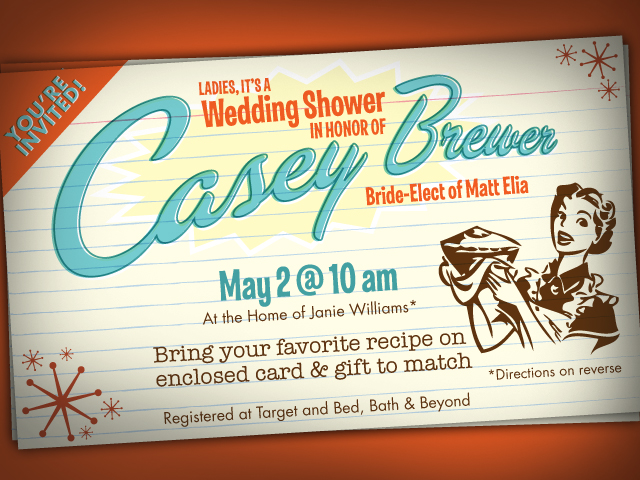
My friends Matt and Casey got married earlier this year. My wife hosted Casey’s wedding shower and asked me to “design something real quick.” She had planned a shower where all guests would bring a recipe to help the bride jump start her domestic arsenal. Of course, this brought to mind the idealistic housewife from the 1950′s. Also appropriate to that genre was the orange and aqua color combination employed in the design. To top it all off, I tried “baking-in” the imperfections of screen printing into the design. If you look closely, you can see how some of the lettering is a little offset from the background. The final printed product was a 3×5 card to mimic an index card (ya know, for recipes). You may even be able to see the light blue and red rules in the background.

Casey Brewer Wedding Shower Invitation

Casey Brewer Wedding Shower Invitation

Casey Brewer Invitation Detail

Casey Brewer Invitation Detail

Taking on the task of developing an entire identity system for a company can be a daunting and difficult task. Nonetheless, it can be one of the most rewarding exercises in blending creativity with discipline. Most clients can’t afford to drag that process out over long periods of time. However, with a little patience, a strong identity can be built over a series of projects without bottlenecking the process in a design studio.

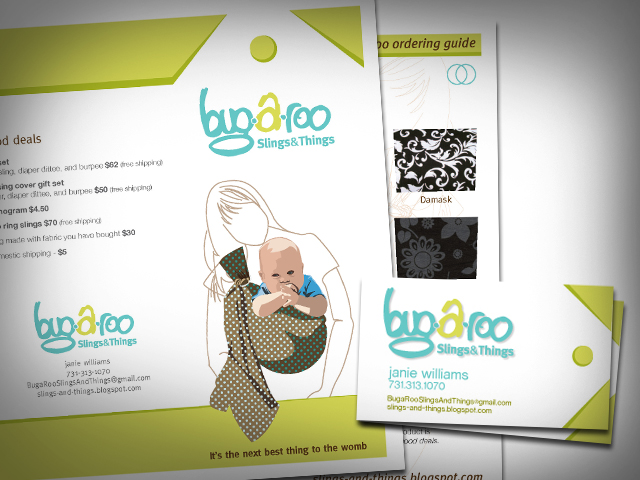
I’ve already posted about the evolution of the bug-a-roo logo project. Over the last week, that identity grew a little stronger. With a sales event pending, we needed some fresh marketing materials. We’ve always been on a tight budget so instead of spending a lot of money on die-cutting business cards, we’ve just cut a couple of corners off and punched some holes to give the impression of a sales tag. Well, that gets old fast so this was my opportunity to simplify. The solution ended up being implying that tag with shape. However, instead of the drawing the shape of a tag, I just drew the impression of a background. Using a darker shade of the main green pantone color, I added a sliver beneath to imply a shadow. I liked this so much that I carried it over to the brochure. bcards_single

The brochure was a redesign of something I threw together in about an hour for the last event. Since that was done around midnight, it looked uninteresting. I carried the green color and tag impression over to the brochure to see if I could still use it. It was starting to take shape so I stuck with it.

Old bug-a-roo brochure (front)

Old bug-a-roo brochure (front)

Old bug-a-roo brochure (back)

Old bug-a-roo brochure (back)


The previous design had a photograph of my wife holding our son in a baby sling. We didn’t have any more photos on hand so I decided to illustrate the old photo. If you are familiar with Adobe Illustrator, you know that you can click a button and, presto! you have an illustrated image of your photograph. That’s no fun, though. Besides, you get some funky-ness that doesn’t look quite right. If you do it by hand, not only do you get to brag about it, but any funky-ness is your own fault! This took HOURS. I had a blast, though. I worked with a skintone color palette, and created dimensional shapes and patterns to imply depth. It felt like the good ole days of paper and pencil. 

This illustration technique had been on my mind quite a bit. I had wanted to do something similar for bug-a-roo for a long time but didn’t have the opportunity until now. We’ll see if it shows up again. Again, that is the beauty of taking your time to develop a visual identity.


Illustration example

Illustration example


Well, I have to sign off because I have to be Mr. Mom so my wife can go sell these products. We’ll see how it goes. Check her blog out and order stuff from her: slings-and-things.blogspot.com.


bugaroo_brochure_page_1bugaroo_brochure_page_2

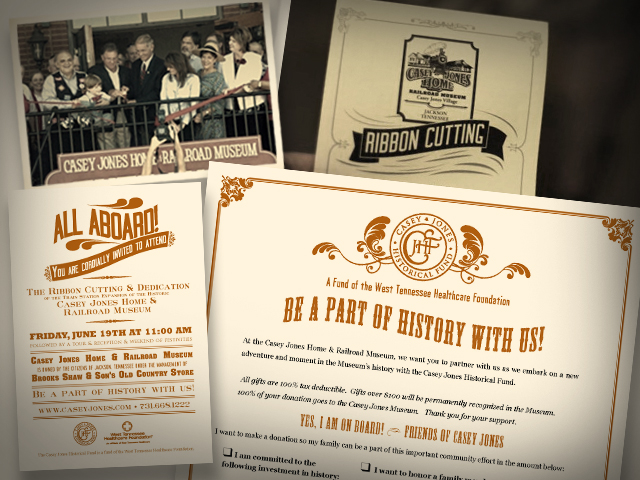
One of the first projects I did for Casey Jones Village was a promotional campaign for the grand opening of their train museum. I have seen my fair share of grand openings and they are generally not very impressive. At best, they tend to be an admirable effort. That is, until this museum opened. I was overwhelmed by the energy and excitement of everyone present. That is the kind of energy and excitement that inspires me to rush into the studio and get back to work.The campaign was a simple project: invitations, ceremony program, information form, and a logo. Since I’ve already blogged about the logo, I’ll just summarize the other components:


Invitation for the Casey Jones Home & Railroad Museum

Invitation for the Casey Jones Home & Railroad Museum


The invitations were fun because it forced me to research some of the design practices of the late 1800s and early 1900s. There is a lot of floral scroll work and whimsical ornamentation. It is rare to find display type that hasn’t been warped or shaped in some exotic way. Next was the informational type. Modern design frowns on the use of many typefaces in a single design. Turn-of-the-century design is just the opposite. It was hard to let myself do it but the result was a nice nostalgic effect. This was a single color design, 5.5×8.8 (about), on a cream color card stock.


Program for the Ribbon Cutting Ceremony of the Casey Jones Home & Railroad Museum

Program for the Ribbon Cutting Ceremony of the Casey Jones Home & Railroad Museum

For the program, it was decided to print in black and white, in-house. Referencing an old mortgage bond for the Greenville & Columbia Railroad Company, I fashioned the little lines surrounding the “Ribbon Cutting” banner. The rest of the typesetting has a more formal feel due to the formal nature of the ceremony. 


Casey Jones Historical Fund Form

Casey Jones Historical Fund Form

Finally, the Casey Jones Historical Fund form was created to distribute to folks interested in contributing a donation. Although forms aren’t too exciting, it was another opportunity to play with the ornamentation around the logo. 

I’d like to thank the folks at Casey Jones Village and encourage you to visit them if you are ever coming through Jackson, Tennessee on I-40. It’s right off of the highway and it’s a lot of family fun. Thanks, also, to Heather Hornbeak at Cedarway photography for the photo of someone (probably her) holding the program. Check Cedarway’s stuff out as well.

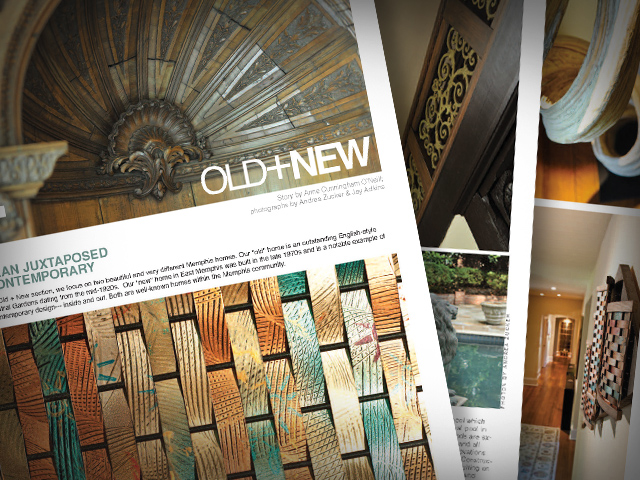
The role of a designer is distinct from any other artist. Designers take elements from other disciplines (photos, type, drawings, illustrations, etc.) and present them in a clear, logical fashion with the result of a strong message. So it makes sense that the better quality of materials provided to a designer, the more inspiring he or she is to create great work.Each month, VIP Memphis Magazine publishes an architectural feature showcasing a new structure alongside an older structure. Sometimes the juxtaposition is stark, sometimes is is subtle. Now, I’ve worked with magazines for several years and have learned that a good idea isn’t enough. I’ve designed home features, human interest stories, interviews, etc. with awful imagery. Those projects are difficult to get through because no matter how clever you are and no matter how far down you reach into your creative bag-o-tricks, at the end of the day, those low resolution, poorly lit, unimaginatively composed images stick out like the ole proverbial sore thumb. 

Not the case with VIP Memphis’ Old+New feature. Two of my favorite photographers to work with have been shooting the featured homes for nearly a year. Each month, as I wait for those big-ole jpgs to download from my FTP server,  I can’t wait to see the angular compositions, the sharpness, the contrast, the depth-of-field, the emotions, and clarity these artists produce regularly. Andrea Zucker and Jay Adkins have both been shooting in the Memphis area for years. I must admit, I’ve been spoiled. It is difficult to go back to point-and-shoot snapshots that have been compressed a thousand times and expected to print/display at twice the original resolution. These photographers have been honing their craft for many years. I cannot recommend them enough.

What this means to me as a designer, at least for this particular feature, is to humbly take a step back and layout their work in a way that doesn’t compete for attention. With poorly shot photographs, it is the designer’s responsibility to distract the viewer with an interesting design. With photos like these, it is exactly the opposite. 

I downloaded the images for next month this morning. If you live in the Memphis area, be sure to pick up a copy of the magazine to see the work these folks are churning out.

oldnewjune09_03_page_1oldnewjune09_03_page_2oldnewjune09_03_page_3oldnewjune09_03_page_4oldnewjune09_03_page_5oldnewjune09_03_page_6

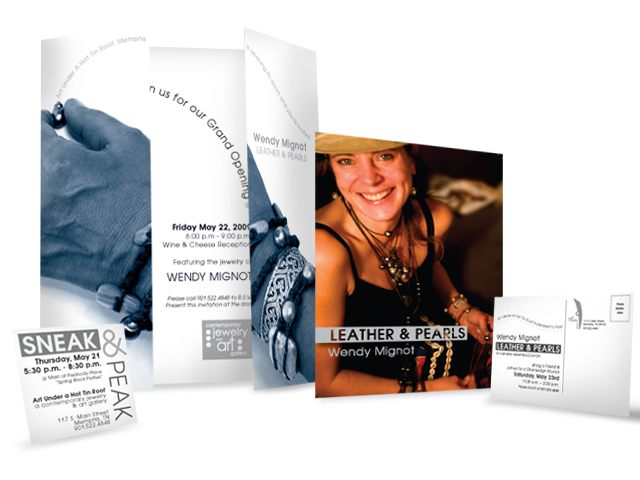
Campaigns present different challenges than stand-alone pieces. For starters, each piece in a campaign, whether it be an ad, a marketing endeavor, or, as in this case, an event promotion, bears a portion of the overall responsibility. In stand-alone pieces, you have one shot to get the message across. What you say has to appeal to a broad audience. In a campaign, each piece is responsible for a segment of the audience. This project promoted a three-day grand opening event for a new art and jewelry gallery in Memphis, TN. Each day targeted a distinct audience.

The first day targeted street traffic generously provided by the Memphis in May Music Festival. For this audience, a low-cost, small format (2.5″ x 2.5″) card was handed to passersby to raise awareness and generate a buzz. The next evening, a VIP artist reception was held featuring jewelry designer, Wendy Mignot. For this, a gate-folded, two-color invitation was designed, printed, placed in a metallic silver envelope, hand addressed, and sent to a list of art enthusiasts throughout the city. This element was appropriately the most elaborate and expensive part of the campaign. Finally, the last event was an invitation-only champagne brunch with a come-and-go vibe. Obviously informal, we chose to send out a color postcard to a broader audience. This final event proved to be a happy medium between the previous two events both in scale and promotion (not to mention production costs). 

The campaign was topped off by a couple of email blasts sent out by the gallery owner. I designed two images to promote two of the three events. You can check them out below. I had a great time working on this project and look forward to doing more in the future. If you are ever in Memphis and would like to check out a great gallery, go to Art Under a Hot Tin Roof at 117 S. Main (Downtown). Also, their original location is in downtown Jackson, TN. Drop in and say “hi.”


Art Under a Hot Tin Roof: Email Blast for VIP Reception

Art Under a Hot Tin Roof: Email Blast for VIP Reception

Art Under a Hot Tin Roof Email Blast for Champagne Brunch

Art Under a Hot Tin Roof Email Blast for Champagne Brunch

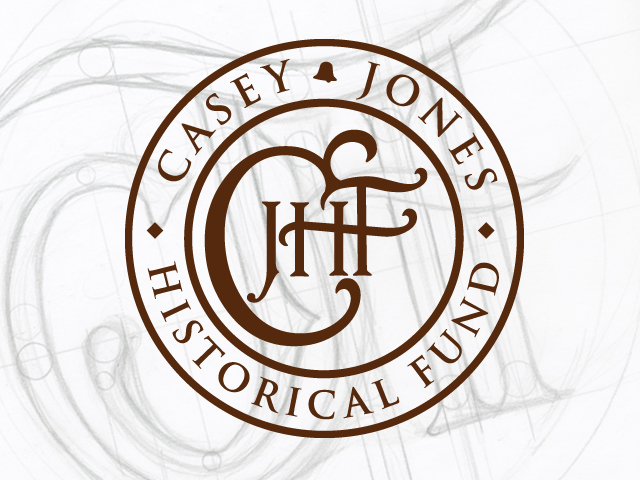
Casey Jones was a heroic train conductor who sacrificed his own life to save all of the passengers on his speeding train when it collided with a stalled freight train in 1900. Jones was originally from Jackson, Tennessee, so it would be fitting for a tourist attraction to be established in his name. Casey Jones Village and BWCreative began a working relationship in late April of 2009. One of the many projects commissioned was a logo for the Casey Jones Historical Fund.

This fund was established in partnership with the West Tennessee Healthcare Foundation to benefit the new Casey Jones Railroad Museum. The logo needed to stand alone, apart from the various enterprises under the banner of the Casey Jones Village. Originally, I wanted to try my hand at a horizontal, rectangular wood-cut image of a train. However, after we discussed the project, the client had envisioned a circular design resembling the front of a steam engine. Open sketchbook.

Since late April, I’ve been pouring over train books noting details in train design as well as turn-of-the-century promotional design (I LOVE the public library!). I am still in the process of forcing this obsession on myself; I think this is only the beginning. Any-hoo, one thing I’ve noticed about this period in design is the typefaces. These faces range from the very stout sans-serif to the elegant, scripty style such as I used in this logo. I particularly love the embellished jut from the lower portion of the ‘J.’ I decided to use the initials in this decorative way because I didn’t like the alternatives I kept coming up with. Any image would be a departure from our train-face; a number, as is common in such spots on trains, would confuse the message of the logo. I saw this as an opportunity to develop an identity that is strongly rooted in the period style rather than a literal depiction of what the fund was established to do. 

The sketch you see below was a rough idea of what I wanted to do. In the beginning, I tried tracing this sketch but you can never underestimate the subtleties of a well crafted typeface. I ended up using Harrington as my base and altered the design to achieve the solution you see here. And there’s the key word: solution. Much of design is problem-solving. Sometimes the problem is simple and it doesn’t take much to solve it; sometimes the problem is great and takes a lot of time to solve. Unfortunately, some logo projects, if executed well, will seem like it took ten minutes to accomplish. I’ve grown fond of telling clients that logos are “deceptively simple.” What seems like an obvious and quick solution may have taken hours to accomplish. 

The end result here was completed by our deadline and the client was pleased. I love having a fresh start to an enterprise. Unlike other projects commissioned by Casey Jones Village, I get to be involved in the Historical Fund’s identity from the beginning. Stay tuned to see the development of the Casey Jones Village, the Old Country Store, the Casey Jones Home and Railroad Museum, and the Casey Jones Historical Fund projects. I’ve had a blast working with them and can’t wait to show you more.

casey_jones004_low


Casey Jones Historical Fund Logo

Casey Jones Historical Fund Logo

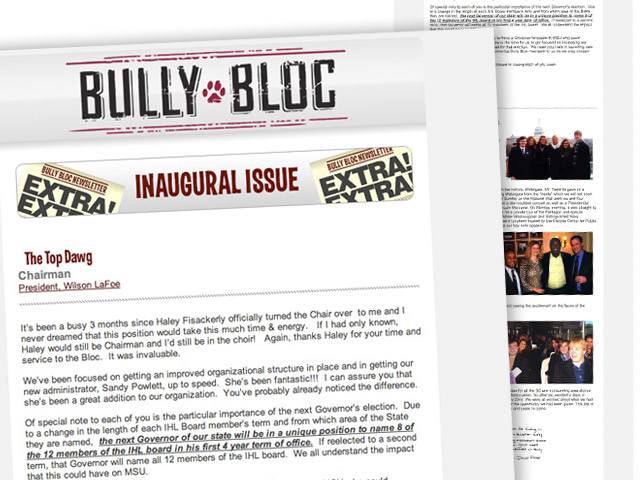
I am no scientist. I am an artist. I like the way things look and beyond simple curiosity, I’m not too interested in knowing why things look the way they do. A web designer is a little different. By default, a web designer must predict why things look the way they do before they make things at all. I’m afraid my curiosity got the best of me, though, and I took on the task of creating this e-newsletter for a political group in Mississippi.

I love to organize information. For this reason, web design has always been fascinating to me. Bully Bloc provided me with a logo, a few pictures, and a lot of text. Normally, I’d go to town in Illustrator or InDesign, but since HTML is somewhat new to me, I had to hold my horses. I utilized a generic email template I found. It was a single column and a simple starting point for me. From there, I created the header, the banner, and the section headings in Photoshop. It is remarkable how much of a conscious effort I had to make when working for web as opposed to print. First of all, I am used to working in CMYK color mode. I’ve learned how to think in terms of four colors of ink and how they relate to each other. In the print world, there isn’t just a single black but there is also a rich black. The simplest of colors must be formulated by mixing Cyan, Magenta, Yellow, and Black. In RGB, there are only three colors to worry about (Red, Green, and Blue). It is color manipulated by light, not ink. Now my color sliders need to be all the way to the right for lighter colors. You get the idea. On top of all of this, web-safe colors are even more limited than CMYK values. Then you have the issue of Raster versus Vector. I’m so used to working with those nice crisp vector lines. I’ve really come to fear pixels as a result. In Photoshop, you have to think in pixels. There are no more inches and half inches, just absolute pixels. In print, everything has to be at 300 dpi; in web, everything is 72 dpi. That’s the difference between playing an XBox and the Atari 2600 (in terms of resolution).

Once that was done, I had to think in HTML and CSS. This is like trying to thread a needle with mittens on. I’m used to grabbing an object and dragging it to it’s perfect location. In HTML, there is a scientific way to tell a browser where that perfect place is. It would be like trying to define exactly why you find a particular person attractive. When your not used to defining things so precisely, it can be a pretty arduous task. Anyway, I choked my way through it and here is the final result. Not bad for a print designer, ehh?

Sending an email campaign is another story but thanks to some help from a friend, I was able to handle that side relatively easily. The newsletter went out last week and I’m already looking forward to doing next month’s. This whole process was a bit addicting. I’m thinking of all of my clients who could benefit from it. I predict I’ll be doing a lot more.

I don’t know if it could be any worse. A logo made up of clip art and Papyrus! Indigenous Outreach International is a mission organization that raises support for indigenous missionaries abroad. It is a small organization but that doesn’t mean they shouldn’t have a brand to be proud of.

After sketching out what seemed like a full sketchbook of ideas, I kept coming back to the initials, I.O.I. The organization is referred to by these initials more than anything else so I felt strongly that the logo needed to communicate this. The result is the flaggy treatment of the initials. By creating the solid ‘I’s, we were able to insinuate the ‘O’ between them by only placing the negative space. What we are left with is a memorable logo mark that isn’t completely dependent on the text to its left. 

The organization’s main location of operations is in Addis Ababa, Ethiopia. Surrounded by a lush and muddy countryside, Addis is full of greens, dark oranges, and various shades of neutral colors. It seemed natural to establish these colors as I.O.I.’s palette. 

I am happy to report that after years of hailing Papyrus as a worthy font choice, I.O.I. has reconsidered its typefaces. Hallelujah. You can visit them on the web at www.ioiusa.org.